
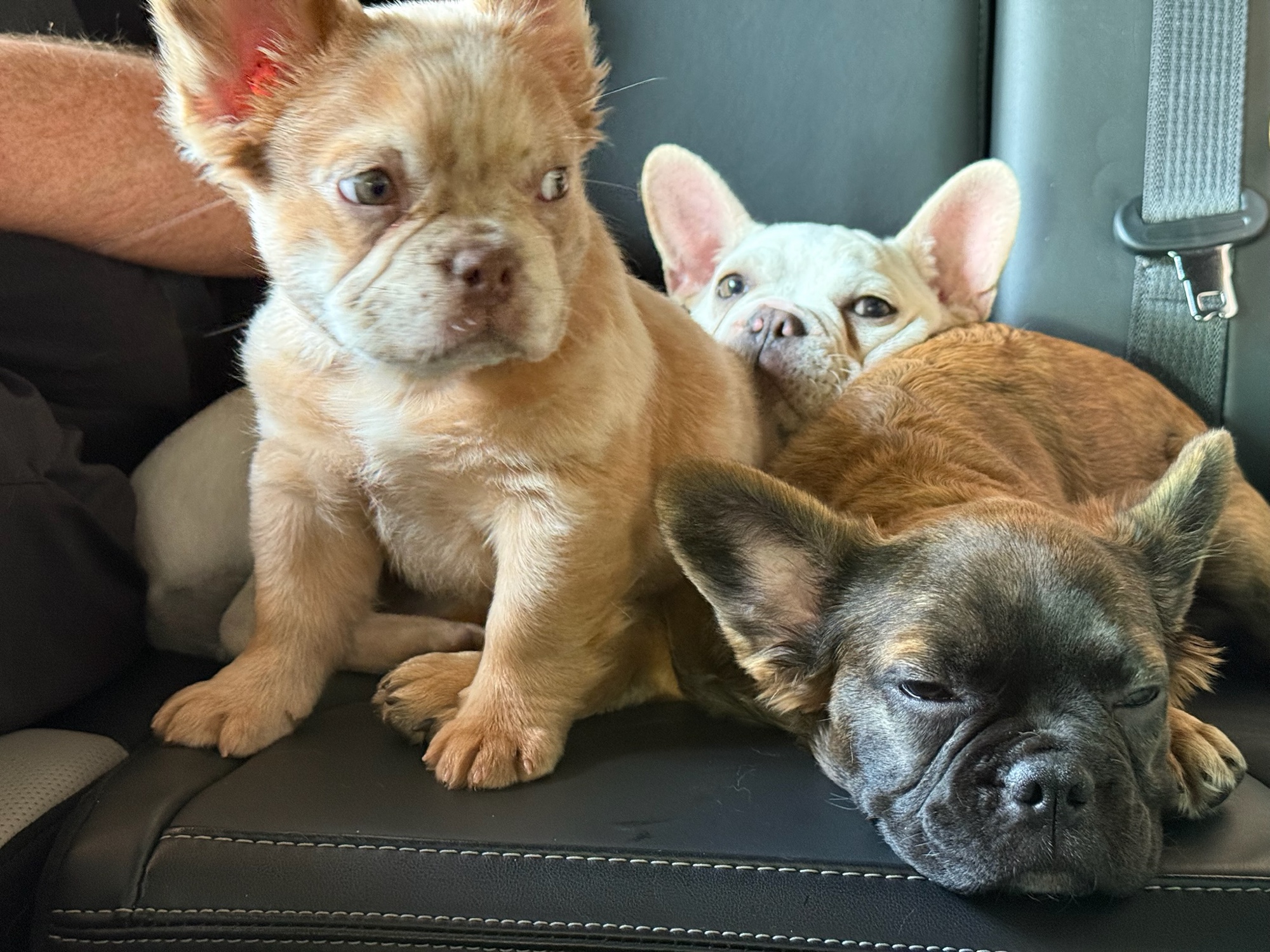
A dog we produced should never have to depend on a stranger's kindness. That is the entire idea behind this page, and everything below is the machinery that makes it enforceable.
01
The chip stays in our name
For the life of the dog. A scan anywhere in the country reaches us.
02
A take-back clause in every contract
Mandatory, not optional. Any dog, any age, any reason.
03
Placement is never rushed
The right home or no home. We will keep a puppy as long as it takes.
Commitment one
The microchip stays in our name.
Your dog is chipped before it leaves, and the registration stays in our name for the dog's life. You are listed as the owner and primary contact — you will always be called first — but we remain permanently attached to the record.
The reason is simple. Chip registrations go stale. People move, change numbers, let a registry lapse, sell a dog and never transfer the record. When a lost or surrendered dog gets scanned at a shelter or a vet clinic, what the scanner turns up is often a phone number that stopped working four years ago.
If a Maison de Brume dog is ever scanned anywhere, the call comes to us. Not a chain of former owners. Us. We answer, and we come get the dog.
Commitment two
The take-back clause.
Every contract we write includes a mandatory take-back clause. Any Maison de Brume dog, at any age, for any reason, comes back to us.
Not to Craigslist. Not to a shelter. Not to a friend of a friend who "has always wanted one." Life goes sideways — divorce, illness, a move, a new baby with an allergy, a financial collapse nobody planned for. None of those make you a bad person, and none of them are the dog's fault. You call us and the dog comes home.
There is no penalty clause, no shaming, and no interrogation. The only thing we ask is that you call us first, before the dog ends up somewhere we can't reach it.
Commitment three
Placement is never rushed.
I want every puppy placed in its perfect home. I have no problem keeping a puppy until I find that home. That is the definition of ethical breeding.
A puppy that stays here an extra two months costs me money and costs me time and is entirely fine. A puppy placed into a household that was a poor fit costs that dog its whole life. Those two risks are not comparable, and pricing pressure is not a reason to accept the second one.
Practically, that means we ask nosy questions, we ask for a veterinarian reference, and we will tell you if we think a different puppy in the litter suits you better than the one you fell in love with in a photo. Sometimes we say no. It's never personal — it's the only leverage we have on behalf of an animal that can't advocate for itself.
The data
Where shelter dogs actually come from.
The story most people carry is that shelters are full of purebred dogs discarded by breeders. The data does not support it.
A large 2018 study of US shelter populations, published in PLoS ONE and available through PubMed Central, found purebred dogs to be a small minority of shelter intake — around five percent — and also found that visual breed identification by shelter staff is frequently wrong when checked against DNA. The NAIA Shelter Project's analysis of purebreds in shelters reaches a similar figure, and notes that if you remove Chihuahuas and Pit Bulls — the two most misidentified and most overrepresented groups — the purebred share drops to roughly 3.3%.
So where do the dogs come from? Overwhelmingly, from operations with no relationship to the animal after the sale: puppy mills and backyard breeders. Those sellers don't take dogs back, don't keep chip registrations, don't screen buyers, and don't answer the phone in year seven. Ethical breeders with enforced take-back clauses almost never see their dogs in shelters — not because they're lucky, but because the contract makes the shelter unnecessary.
This is why the take-back clause is the single most important piece of paper in this business. It's also the one most people never ask to see.
Vocabulary
Know your breeder.
"Breeder" covers five wildly different operations. Learn to tell them apart and most of the risk in buying a dog disappears.
Puppy mills & commercial
Volume operations. Cages, minimal veterinary care, minimal or fabricated health testing, sold through pet stores and brokers. No structural evaluation, no genetic planning, no relationship after the sale. A genetic disaster on an industrial timescale.
Backyard breeders
Accidental or profit-driven. No health testing, no contracts, no take-back, no support after pickup. Usually well-meaning, occasionally not, always under-informed. This is where most shelter purebreds come from.
Hobby breeders
Breed occasionally, out of genuine love for the breed. Health test. Know their lines. Will keep a puppy for life if they have to. Limited scale and limited depth of genetics knowledge, but honest and attached to their dogs.
Show breeders
Breed to the conformation standard, health test rigorously, campaign their dogs. Deep pedigree knowledge and real accountability to a community — but can over-index on show traits when the standard itself rewards the exaggeration causing the health problem.
Preservation / professional
Full-time. Deep genetics knowledge. A comprehensive health protocol: DNA testing plus an independent second-lab verification, radiographs, BOAS grading, coefficient of inbreeding tracked across pairings. Lifetime contracts, enforced take-back, careful placement. This is where we sit — and here’s exactly where we are in that build-out today.
Open book
Nothing to hide.
This is what a Maison de Brume contract looks like. Available on request before you apply — read it, take it to a lawyer, take it to your veterinarian, ask us about any clause in it.
We have nothing to hide. Everything to protect.