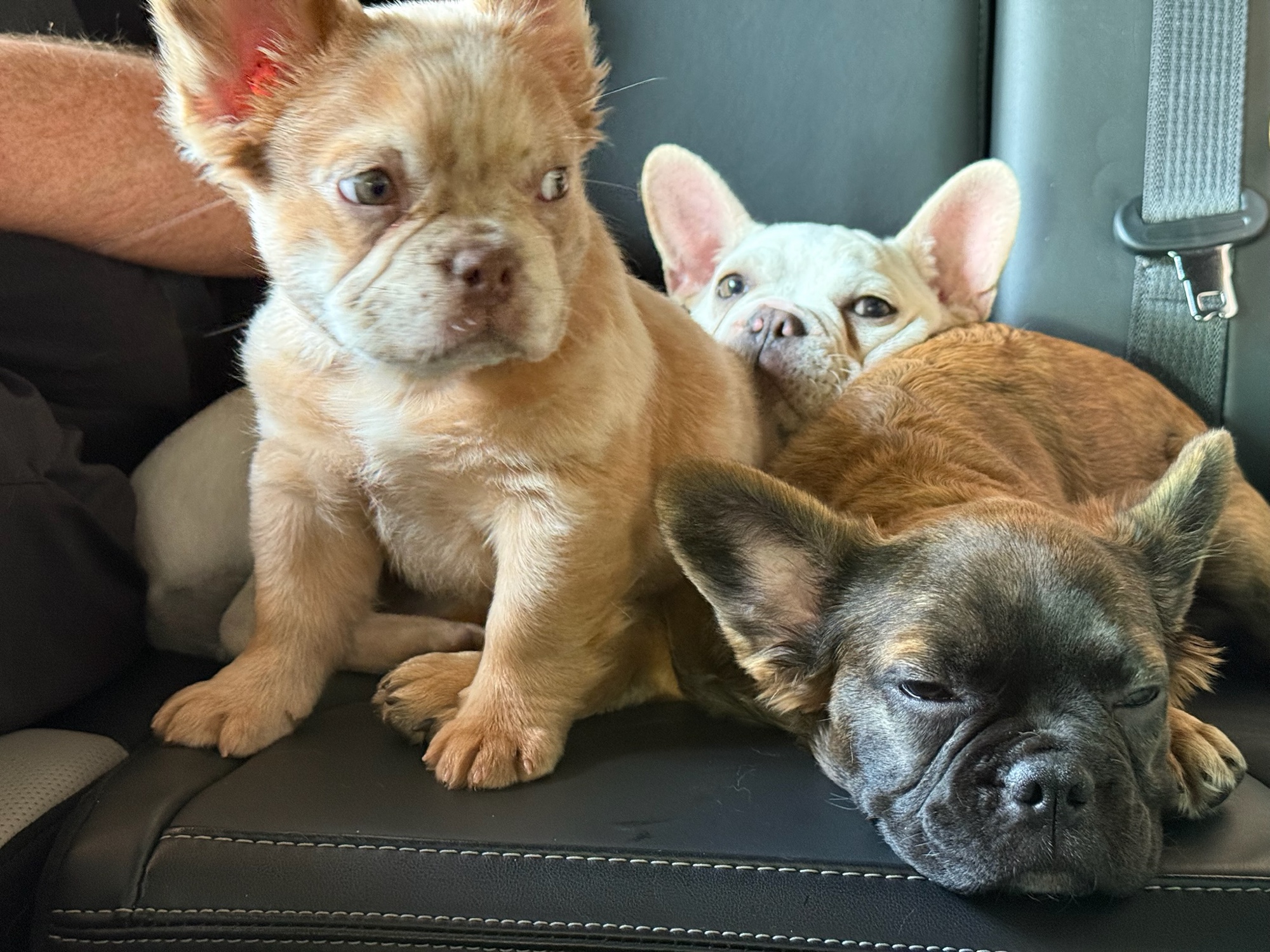
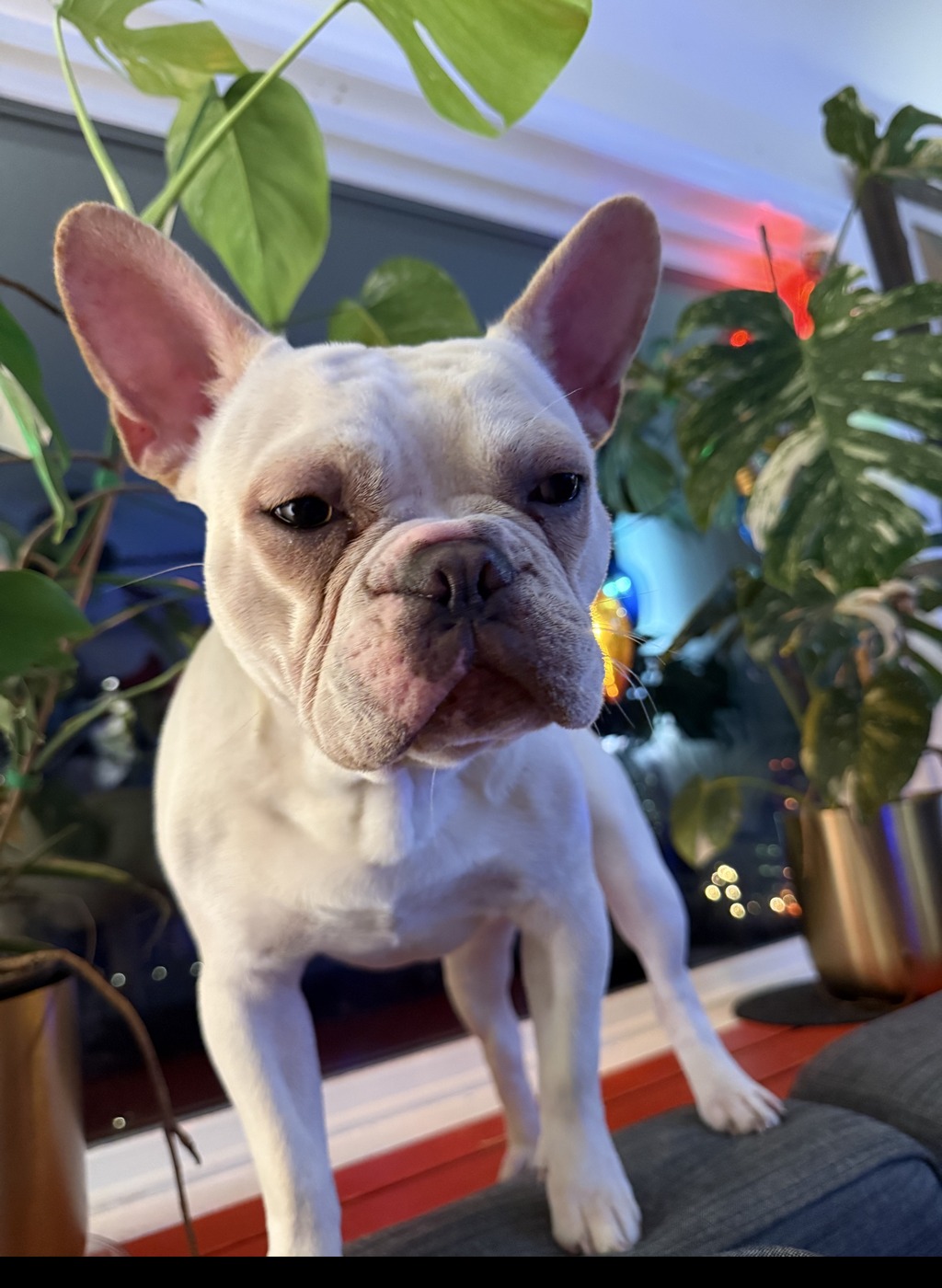
A Frenchie isn't just a smushy face. It's a spine, a soundtrack of breathing, a temperament, a structure that lets a small dog live a long full life.
Almost everything sold in this breed is sold on the face. Color, wrinkle, ear set, eye. Those things are real and I care about them — but they are the last four percent of the dog. The first ninety-six percent is whether the animal can breathe on a warm day, walk a mile, hold its own spine together, and stay emotionally steady in a house full of noise.
That's what we breed for, and that's why our selection decisions sometimes look strange from the outside. We have passed on stunning dogs. We have kept plain ones.
Practice
Breeding is an extension of an art practice.
I'm a painter — mixed media, mostly. I've been studying genetics since 2006, first as a curiosity and then as an obsession, and at some point the two things stopped being separate activities in my head.
A painting is a set of constraints you accept and then push against. So is a breeding plan. You inherit a material with its own tendencies, you study what it actually does rather than what you wish it did, and you make a series of decisions that either compound into something coherent or fall apart into mud. The difference is that a painting can be wiped back and started again, and a dog cannot. That asymmetry is the entire ethics of this work.
What I'm working toward is easy to say and hard to do: a perfect soul inside a healthy and fit body.
Selection
Structure over panels.
Here is a sentence that gets me into arguments: I will take a four-panel dog with perfect structure over a six-panel-clear dog that can't walk around the block.
A DNA panel only tests what has a known DNA marker. That's it. It is a list of specific mutations someone has found, validated, and built an assay for. It is enormously useful and I run it on every dog in this house — and it tells you nothing at all about the traits that most determine whether a Frenchie gets to live a normal life.
Nose length. The shape and taper of the nostril. Soft palate length. Tracheal caliber. Spinal alignment and vertebral formation. Joint angulation front and rear. Pelvic width and the resulting whelping outlook. None of these are on a panel. All of them decide the dog's future.
A clear panel is a floor, not a ceiling. It tells you what the dog doesn't have. It does not tell you what the dog is.
The lever we actually control
Food is life.
Genetics decide the range. Food decides where in that range your dog actually lives. We can spend two years selecting a pairing on paper and lose all of it at the food bowl — and most breeders, honestly, find the cheapest bag that keeps a dog alive and defend the choice for the rest of their career. A lot of them feed the Costco bag.
I fed raw to my working dogs for years. After the organ transplant, an immune-compromised person cannot handle raw meat safely, so I had to find a commercial diet that lived up to the standard I had set with raw. Years of reading canine nutrition studies landed me on Farmina, on FortiFlora from the day puppies start solid food, on Calming Care for the anxious ones, and on Bernie's Perfect Poop for the gas Frenchies are famous for. Each of those choices is defended by peer-reviewed literature and by results on my own dogs.
Nutrition is a real part of this program, not an afterthought. It is long enough that it lives on its own page.
The gap
What genetic testing can't tell you.
Four examples, because these four cause most of the suffering in this breed.
BOAS — no DNA test exists
Brachycephalic Obstructive Airway Syndrome is the defining welfare problem of flat-faced dogs, and there is no DNA test for it. Estimates put clinical signs in somewhere between half and seventy percent of French Bulldogs, and the disease is a direct consequence of skull conformation rather than a single mutation — see UFAW's genetic welfare assessment for the breed. The only way to catch it is to assess the actual animal: nostril aperture, palate, larynx, and functional performance under exercise.
Hemivertebrae — no DNA test exists
Malformed vertebrae are close to universal in this breed. Radiographic surveys find some form of vertebral malformation in the large majority of French Bulldogs — UFAW documents the link to the screw-tail conformation, and the trait has been shown to be moderately heritable in French Bulldogs specifically. There is no panel for it. Spinal radiographs are the only screen, which means you either shoot films on your breeding stock or you are guessing.
Cherry eye — no clean Mendelian test
Prolapse of the third eyelid gland has no reliable single-gene test. Family history is the only real tool: who produced it, out of what pairings, at what rate, and how often it recurred after surgical repositioning. That requires breeders who tell the truth about their own litters — which is exactly what the market punishes.
IVDD — a linkage test, not a mutation test
The commonly used IVDD result is a linkage test — it detects a marker that travels near the causal variant rather than the variant itself, and Embark's own explanation of Type I IVDD testing makes the limits of that approach clear. Linkage can break. False negatives happen. Treating an IVDD result as a guarantee is a misreading of what the assay does.
A mission line
Breeding cherry eye out of our lines.
Cherry eye is my personal project. It is common, it is painful, it is surgical, and it is almost never discussed honestly because admitting a produced case costs a breeder money.
We track it. Every dog we consider is evaluated for prior prolapse and for family history on both sides, as far back as I can get anyone to talk. When a line shows a pattern, that line is out of our program — not managed, not bred around, out. That has cost us dogs I wanted badly.
I don't claim we have eliminated it. Nobody honest claims that. I claim we are selecting against it deliberately, generation over generation, and that we will tell you exactly what we know about any dog we place with you.
In order
Structure. Temperament. Health. Soul.
Structure, because it determines whether the body can do its job for fifteen years. Temperament, because a dog that can't live in a family isn't a companion. Health, because the panels and the radiographs and the exams are the receipts. Soul, because it's the reason anybody does this at all.
This is what we breed for. In that order.